
In the open, $200–$500
A visible, reachable burst, garden, garage, accessible wall, cut out and repaired at business-hours rates.
First we stop the water. Then we find the actual split, not just where the water shows up, which is rarely the same place, and repair it properly. On call around the clock across Parramatta and the Western Sydney.
Most of what bursts around Parramatta is age meeting pressure. Original copper lines from the mid-century build era wear thin from the inside until a pinhole opens; older galvanised steel rusts until a fitting lets go; and garden poly lines split where a root or a shovel found them years ago. Add mains pressure that runs high across parts of the Western Sydney, and the weakest point eventually announces itself.
The catch is that water travels. It runs along the outside of the pipe, along joists and wall plates, and surfaces somewhere downhill of the actual split, which is why the wet patch on the ceiling is so often metres from the leak. Repairing where the water shows up fixes nothing. We trace the line back to the failure itself, repair that, and pressure-test before closing anything back up.


Parramatta’s Federation and Victorian homes still run original clay lines that crack and admit roots, a leading cause of slow drains in the older pockets.
Most heritage-era houses are a layered record of every plumber who has worked on them: original galvanised in the untouched parts, copper from a seventies bathroom, and modern pex from whatever was done last.
That matters because a burst tells you about one section, not the house. We will say which era failed and whether the rest of that era is still in service, which is the difference between a repair and an informed decision about the next five years.
The CBD’s dense apartment towers share drainage stacks where food waste, grease and wipes build up and back multiple units up at once.
The line is broadly the same as for drains: pipework serving only your lot is yours, and anything serving the building, risers, mains, common-property pipework, belongs to the owners corporation.
Where it gets argued is damage. A common-property pipe that damages your contents usually engages two policies, and the way to keep that simple is contemporaneous evidence. We document time, source and cause on the night for exactly that reason.
Parramatta (postcode 2150) is Western Sydney’s second CBD, set on the Parramatta River and bordered by Harris Park, Westmead, Rosehill and North Parramatta. Its mix of apartment towers and Federation cottages gives its drains a real split personality, and we handle both.
Mains pressure varies with elevation, and properties low on a slope frequently sit at the high end of the range. Higher standing pressure shortens the life of every fitting in the house, particularly flexible hoses under sinks and behind toilets.
If you are at the bottom of a hill and you have had more than one fitting let go, a pressure test is worth doing. A pressure-limiting valve is a small part that prevents an expensive category of failure.
Not every escape of water is a burst pressure pipe. A cracked or collapsed drain leaks too, slowly, without a pressure drop, and often for months before anything shows.
The distinction matters because the repairs are different jobs at different prices. A pressure leak shows on the meter with every tap closed; a drain fault does not, and it is found with a camera rather than a listening device.
In an apartment you generally cannot use the street meter, that serves the whole building. What you need is your lot's own isolation valve, usually in the laundry, a hallway cupboard, or a riser cupboard on your floor.
Find it on a calm evening and make sure it turns. A valve that has not moved in fifteen years sometimes will not, and discovering that at midnight with water running is a much worse time to learn it.
A bill that has risen with no change in the household is the most common way a concealed leak is discovered, and by then it has usually been running a full quarter.
Sydney Water's own comparison of your usage against previous periods is the easiest check available. A steady climb across two bills, with no new occupants and no new garden, is a leak until proven otherwise.
Not every burst announces itself. A pressure leak under a slab or inside a wall can run for months, and the symptoms are indirect: a water bill climbing without explanation, a warm patch on the floor, a musty smell, paint lifting at skirting level.
The free first test is your meter. Turn every tap off, note the reading, and check it an hour later. If it has moved, water is leaving somewhere, and that is worth finding before it finds you.
A visible, reachable burst, garden, garage, accessible wall, cut out and repaired at business-hours rates.
Adds the tracing and the careful access: finding the true split before opening anything, so only one hole gets made.
Detection gear, concrete access or a reroute. Precision here is the whole cost battle, small hole, right place.
Roughly $180–$250/hr against $120–$160 daytime, plus call-out. With the meter off, morning is sometimes the smarter spend, we will tell you honestly.
Leak detection's first hour, locating the failure before demolition, reliably cheaper than exploratory holes.
Every repair is pressure-tested before we leave, and the workmanship carries a lifetime warranty. Figures here are indicative of the 2026 Sydney market rather than a quote from us, you get your own number as a fixed price before any work starts.
Meter valve clockwise: we walk you through it on the phone, and the flood stops before the van starts. On site we isolate just the injured line when the layout allows it.
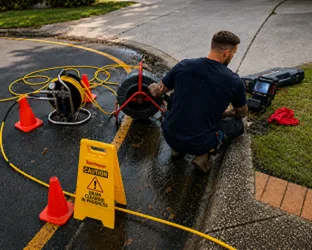
Acoustic listening, thermal imaging and section-by-section pressure testing find the actual split, which is rarely under the wet patch.

The damaged section is removed and replaced properly. If what we expose says the whole run is finished, you hear it straight, with prices for both roads.
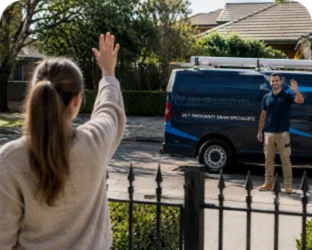
Mains-pressure test before anything closes. The repair demonstrates itself; then, and only then, do surfaces go back.
Shut the meter valve, then call. We will talk you through making it safe while a crew heads your way.
One fixed price, one properly repaired pipe, one pressure test you watch pass. That is the whole offer.

Leave your details and our local Parramatta team will call you back fast.